

Five common question types and how to search them
A patient asks whether another blood pressure medication will meaningfully reduce their risk. The next consultation raises a different question: will a diagnostic test change what you do? Both require evidence, yet typing the condition name into a search box may produce pages of information without resolving either decision.
An effective evidence search for family physicians starts with the decision: treatment, diagnosis, prognosis, harm or prevention. Identify the question type, define the relevant patient group and outcome, then choose a source suited to that question. This gives the search a purpose before the results arrive.
Evidence based medicine combines research with clinical expertise and patient values. Finding a relevant paper is one part of that process; deciding whether its findings apply to the person in front of you remains a clinical task.[1] The examples below are hypothetical search questions, not treatment recommendations.

Treatment questions compare meaningful outcomes
Treatment searches should clarify what you are comparing and what improvement matters. Population, intervention, comparator and outcome form the PICO framework. Add the treatment duration or follow-up period when it affects the decision.
Example: In adults with knee osteoarthritis managed in primary care, how does supervised exercise compare with usual care for pain, walking ability and treatment discontinuation over six months?
Start with a relevant guideline or systematic review, then examine individual trials when the recommendation leaves an important uncertainty. Look beyond laboratory or imaging changes to outcomes patients experience, such as function, quality of life and adverse effects.[2]
For the osteoarthritis question, a useful answer should help you discuss the expected improvement and practical commitment. A summary that merely says exercise is beneficial has not fully answered the comparison.
Diagnostic questions test whether a result changes the decision
A diagnostic search needs a defined presentation, test and target condition. Specify primary care where possible. A study of patients already referred to a specialist may not represent the people presenting to your clinic.
Example: In adults presenting to primary care with an acute sore throat, how accurately does a rapid antigen test identify group A streptococcal infection compared with throat culture?
Check the reference standard, patient selection, sensitivity, specificity and likelihood ratios. Consider disease prevalence and whether the study population resembles your own.[2] Then ask what a positive or negative result would change: further testing, treatment, reassurance or follow-up.
Keep diagnostic accuracy and management questions distinct. If you also need to know whether a testing strategy improves patient outcomes, make that a second search rather than expecting an accuracy study to answer both.
Prognosis questions need a starting point and time horizon
A prognosis search asks what may happen next. Define when observation begins, the outcome of interest and the period over which it is measured.
Example: Among adults with a first episode of low back pain in primary care, what proportion have persistent activity limitation at three months?
Look for cohort studies with a clear starting population and adequate follow-up. Check whether participants resemble primary care patients and whether those lost to follow-up could change the findings. Prediction tools also need validation beyond the population used to develop them.[2]
Choose outcomes that match the conversation. Return to work, persistent pain and recurrence are different endpoints. An estimate for one should not quietly become an answer about another. Record the time horizon alongside any risk estimate you use.
Harm and medication questions require careful source selection
Medication searches often contain several questions at once: whether an interaction exists, how serious it may be and what action is appropriate. Separate these before searching.
Example: In older adults taking an oral anticoagulant, what evidence addresses bleeding risk after adding a nonsteroidal anti-inflammatory drug, and what prescribing precautions apply?
For a Canadian prescribing question, include a check of the current product monograph and relevant safety communications. Search comparative studies when you need an estimate of risk. Specify the medicines and clinically relevant context rather than asking only whether a combination is “safe”.
Health Canada’s adverse reaction database can help identify reported safety concerns. Its reports concern suspected reactions; they do not establish causation or allow direct estimates of incidence.[3] Do not convert a report count into a patient’s probability of harm or treat the absence of reports as reassurance.
Prevention and screening questions balance benefits and risks
Prevention questions concern people with a defined risk profile. For screening, specify an asymptomatic population and distinguish routine screening from investigating a symptom.
Example: In asymptomatic adults at average risk of colorectal cancer, how does an organised screening strategy compare with no screening for mortality and downstream harms over a defined follow-up period?
Look for an assessment of benefits, false positives, overdiagnosis and follow-up procedures, alongside patient preferences. The Canadian Task Force’s Prevention in Practice series addresses these conversations and the communication of benefits and harms.[4]
Before using a recommendation, check its publication status, intended population and jurisdiction. For Canadian practice, confirm the applicable provincial pathway as well. Make disagreements between recommendations explicit, and identify whether they reflect different populations, evidence assessments or priorities.

A practical workflow from question to decision
Write the decision in one sentence before opening a search tool. Include only details that could change the answer. A focused comparison usually needs more than a disease name, but it does not need the patient’s entire history.
When searching PubMed, Clinical Queries offers filters for therapy, diagnosis, etiology, prognosis and clinical prediction guides. A narrow search favours specificity; a broad search favours sensitivity.[5] If the initial search is unhelpful, revise the terms or broaden the scope. These filters assist retrieval; they do not replace appraisal.
For each promising source, check the date, population, comparison and outcome. Open the relevant passage and decide whether it answers your question. Finish with a brief note of what the evidence supports, what remains uncertain and how the patient’s preferences affect the next step.[1]
Using AI while keeping the evidence visible
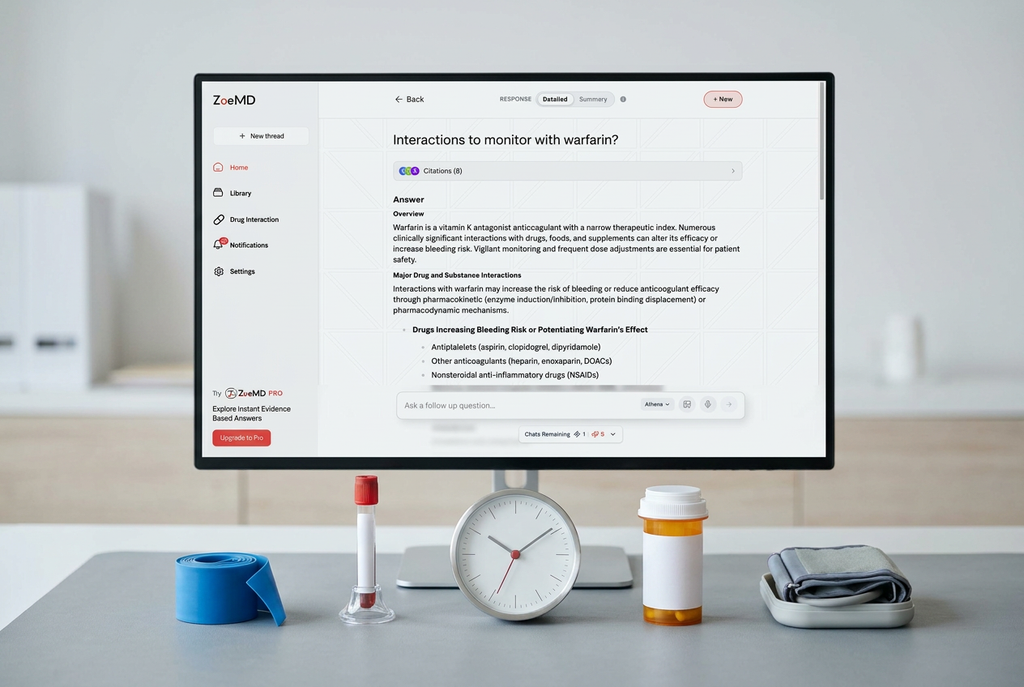
ZoeMD’s official website describes natural-language clinical questions and responses with citations and links to source materials. These features can provide a route into the literature; they are not proof that a particular answer is correct.
When using an AI summary, open the sources behind consequential claims and check their fit with the question. Do not assume that a citation validates every sentence. The guide to clinical reference tools for primary care offers a related framework for evaluating this workflow.

For your next search, start with one unresolved decision and choose the question type before choosing keywords. To explore this approach with an AI medical assistant, visit ZoeMD. Keep the original evidence, clinical context and patient’s priorities in view. Explore this approach with an AI medical assistant – Sign up today.
References
1. American Academy of Family Physicians. Evidence-Based Medicine (EBM) [Internet]. American Academy of Family Physicians; 2026 May [cited 2026 Sep 26]. Available from: https://www.aafp.org/about/policies/evidence-based-medicine-ebm
2. American Academy of Family Physicians. Evidence-based Medicine Toolkit [Internet]. American Academy of Family Physicians [cited 2026 Sep 26]. Available from: https://www.aafp.org/afp/authors/ebm-toolkit
3. Health Canada. Interpretation of Suspected Adverse Reaction Data [Internet]. Government of Canada; 2017 May 4 [cited 2026 Sep 26]. Available from: https://www.canada.ca/en/health-canada/services/drugs-health-products/medeffect-canada/adverse-reaction-database/interpretation-suspected-adverse-reaction-data.html
4. Canadian Task Force on Preventive Health Care. Prevention in Practice Series [Internet]. Canadian Task Force on Preventive Health Care [cited 2026 Sep 26]. Available from: https://canadiantaskforce.ca/guidelines/prevention-in-practice-series/
5. National Library of Medicine. Help: PubMed. Clinical Queries [Internet]. National Library of Medicine [cited 2026 Sep 26]. Available from: https://pubmed.ncbi.nlm.nih.gov/help/#clinical-queries